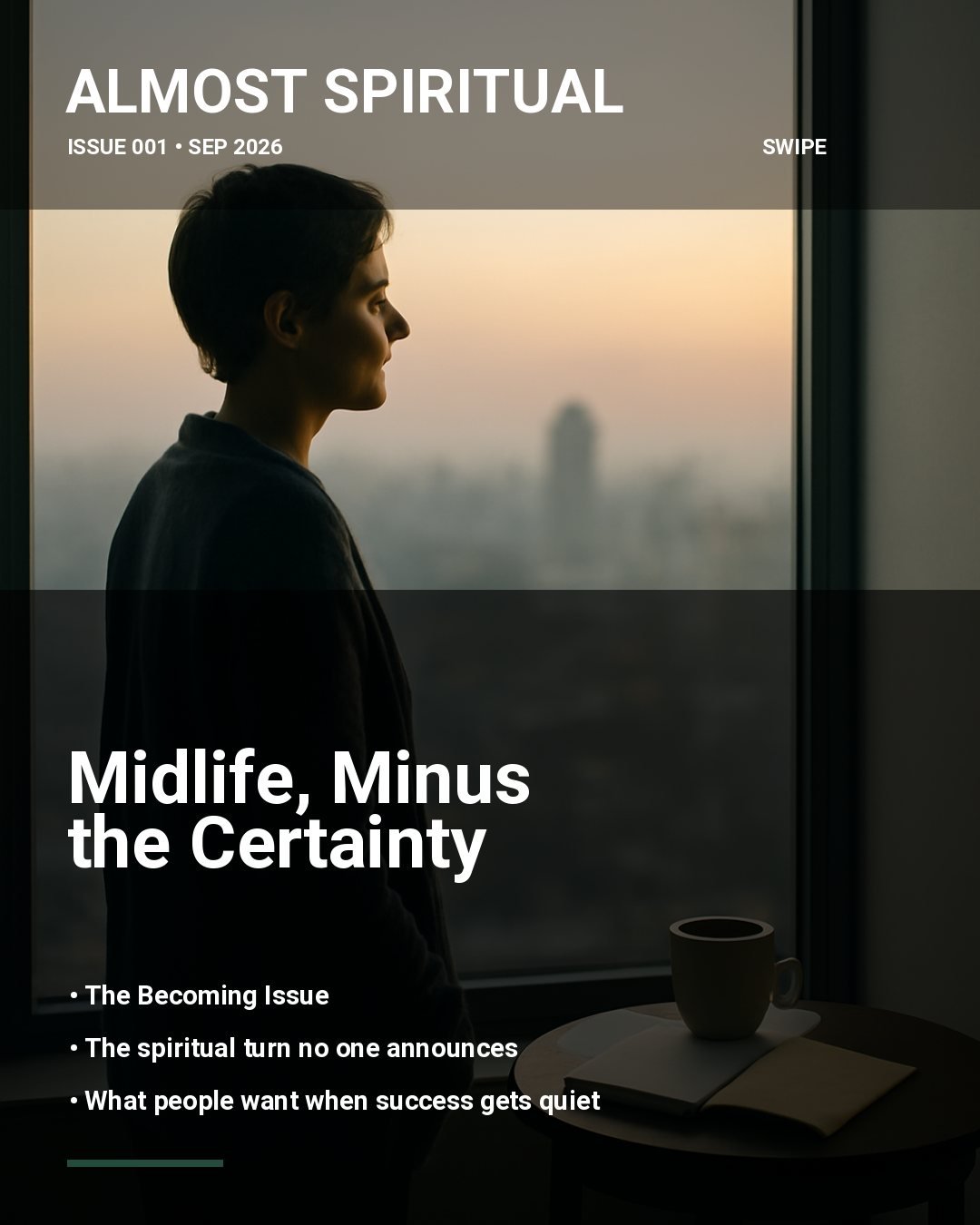
Midlife, Minus the Certainty
Why the becoming years often reopen prayer, purpose, and community.
- The spiritual turn no one announces
- What people want when success gets quiet
From the editor
For a long time, the story of adult life was told as a clean exit from belief: less church, less prayer, less need. The data is messier. Pew finds 64% of U.S. adults think of themselves as spiritual and 22% call themselves spiritual but not religious, while 43% say they’ve become more spiritual over their lifetime. Barna’s latest young-adult survey, meanwhile, says prayer is the top spiritual reason people attend church and about one in three Gen Z and Millennials are going more often than a year ago. pewresearch.org
02Why it matters
The return isn’t to religion alone
It’s to practices that feel honest.
Midlife has a way of making old certainties feel too small. The question is not always whether people are “coming back” to religion; more often, it is whether they’re willing to become more honest about need: for prayer, silence, community, or a language for grief and gratitude. Pew finds 64% of U.S. adults think of themselves as spiritual and 22% say they are spiritual but not religious. pewresearch.org
03Pew / Barna
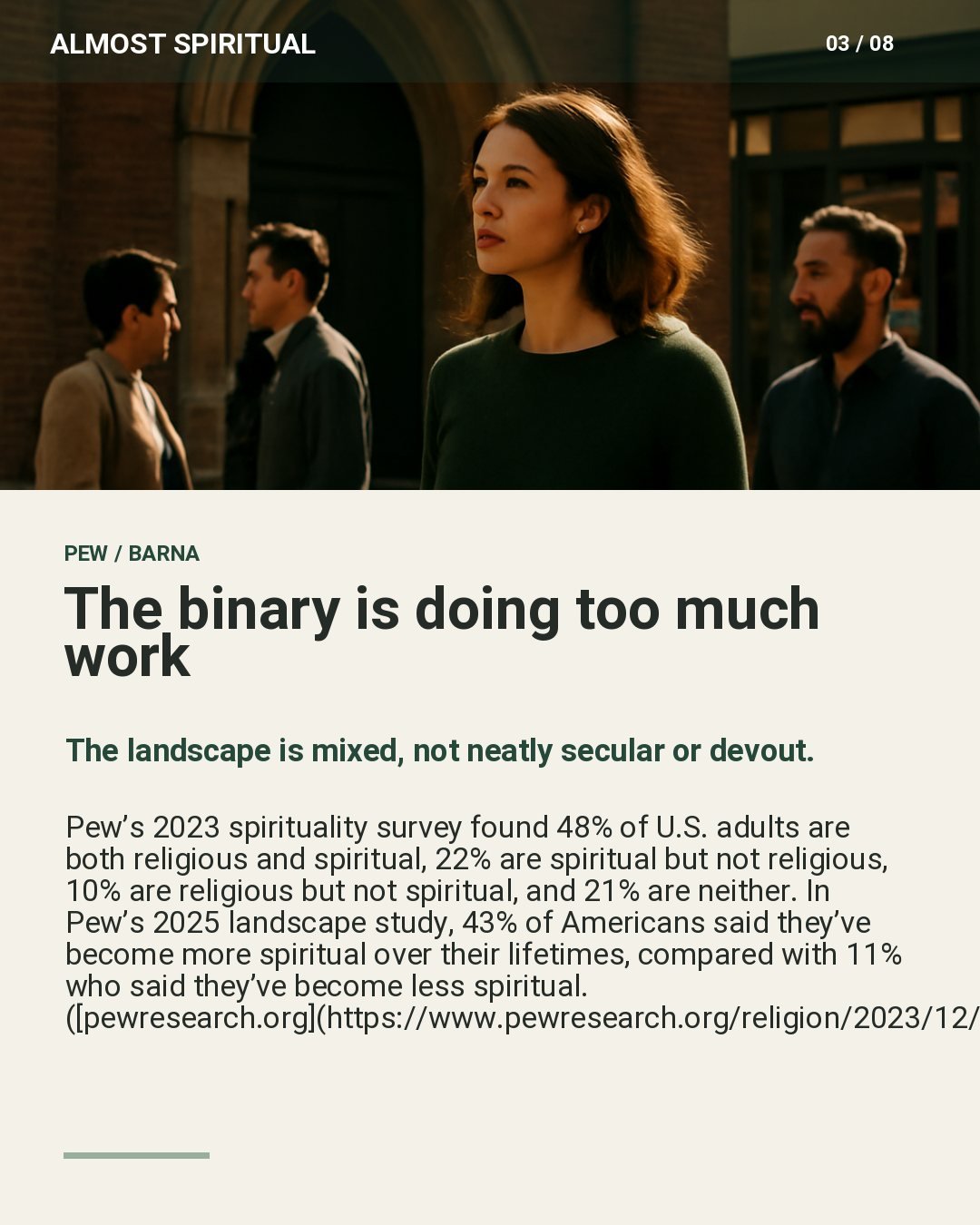
The binary is doing too much work
The landscape is mixed, not neatly secular or devout.
Pew’s 2023 spirituality survey found 48% of U.S. adults are both religious and spiritual, 22% are spiritual but not religious, 10% are religious but not spiritual, and 21% are neither. In Pew’s 2025 landscape study, 43% of Americans said they’ve become more spiritual over their lifetimes, compared with 11% who said they’ve become less spiritual. pewresearch.org
04A line worth keeping
The average isn’t the story
The real story isn’t the average, it’s who’s stirring at the edges. ([barna.com](https://www.barna.com/research/young-adults-spiritual-reasons-church/))
What happens at the edges matters more.
Barna’s survey found prayer was the top spiritual reason young adults gave for attending church, and the people most likely to say they were going more often were not everyone, but a defined slice. That is the useful clue: spiritual change often shows up first at the margins. barna.com
05What spirituality means
Connection is the common thread
Something bigger. God. The true self. Other people.
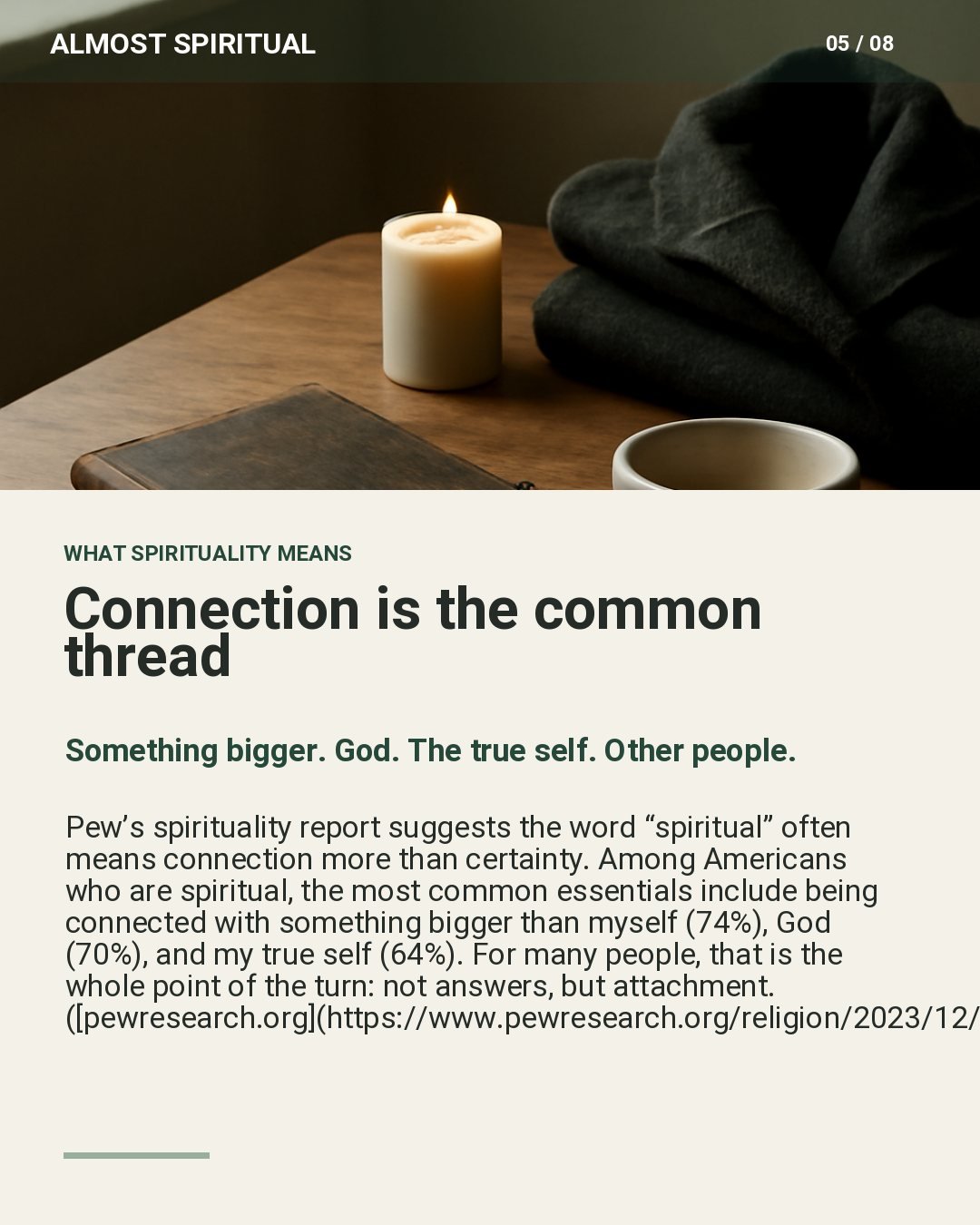
Pew’s spirituality report suggests the word “spiritual” often means connection more than certainty. Among Americans who are spiritual, the most common essentials include being connected with something bigger than myself (74%), God (70%), and my true self (64%). For many people, that is the whole point of the turn: not answers, but attachment. pewresearch.org
06A useful lens
Choose the practice, not the performance
Midlife rarely rewards grand reinvention.
Try changing the question from “What do I believe?” to “What practice keeps me honest?” The right ritual is rarely dramatic. It is the one that survives a bad week: a quiet room, a weekly meal, a walk, a page of journaling, a service you keep showing up for. Meaning usually hides in repetition, not revelation.
07Closing note
Wonder after certainty
A quieter adulthood can still be a spiritual life.
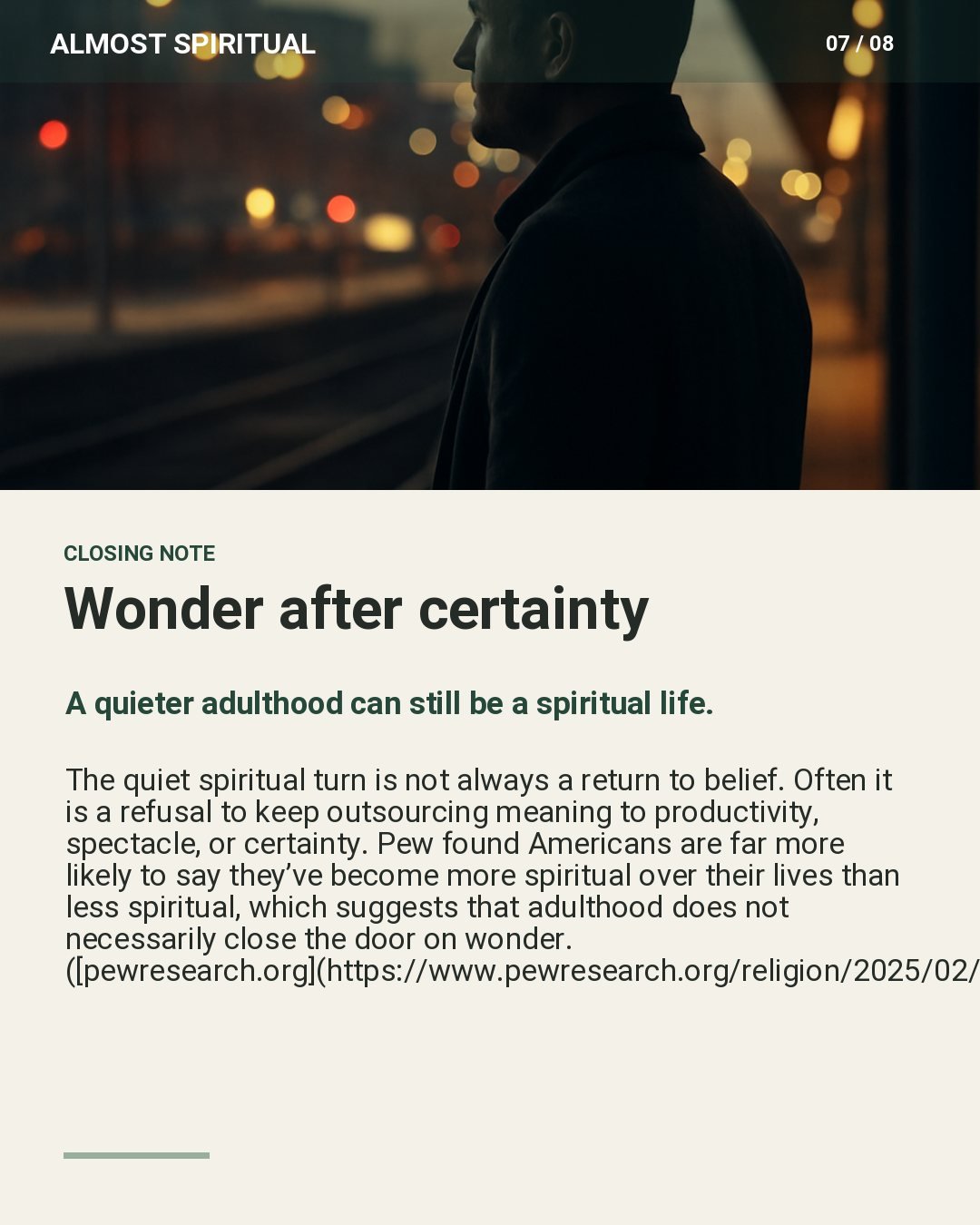
The quiet spiritual turn is not always a return to belief. Often it is a refusal to keep outsourcing meaning to productivity, spectacle, or certainty. Pew found Americans are far more likely to say they’ve become more spiritual over their lives than less spiritual, which suggests that adulthood does not necessarily close the door on wonder. pewresearch.org
08Join the conversation
What changed for you?
Tell us the practice, place, or question you keep returning to.
What changed in your life first: your beliefs, your habits, or your tolerance for ambiguity? Tell us which ritual, room, or relationship has made you feel most awake lately—and what you are still not sure how to call it.
Sources
- What Young Adults Are Looking for Spiritually at ChurchBarna Group, 2026
- US Christian Decline May Be Stabilizing: 2023-24 Religious Landscape StudyPew Research Center, 2025
- Measuring spirituality in AmericaPew Research Center, 2023
Researched and drafted with AI help, then chosen and edited by people at Shifiverse. Every number links to its source.
Your turn
What did this stir up?
Bring it to the Rooms — real people, talking it through.
Go to the Rooms